Showing posts with label teacher training. Show all posts

Saturday, October 1, 2011

Montessori Record Keeping...

When I began teaching in Montessori I found record keeping and taking observation notes was a difficult thing for me to handle and be consistent with. Over time, I have found a stressless way for me to have a plan. Montessori records and lesson plans are all individualized. As Montessori teachers, we "follow" the child through observations to see what the child may need: intellectually, emotionally, socially, physically and spiritually.

First I have a legal sized clipboard. The first page is a Lesson Plan grid with 25 spaces for me to have each child's name. Below are lessons that I plan on giving the child. After I give the lesson, I put a check mark next to the lesson to remind me it has been given.


If you have an assistant that knows what most of the works are called, I would have them record what each child is working on in the morning hours. This has given me more time to focus on lessons to the children and I can really observe the children in the environment instead of, "Sam had snack, cards and counters, etc." You will have time to observe the child and write ample notes. At the end of the morning, my assistant will give me her list. I then transfer this onto my Daily Record Keeping form. This monthly record shows lessons the child had, what they are working on, emotional/social behavior and a parent communication record.

When it is time for me to communicate with a parent, I am easily able to look at my notes and observations. This also allows me to easily transfer my records in the "official" checklist.

Monday, September 5, 2011

Kids Top Five Yoga Exercises

5 Sure-Fire Kids Yoga Exercises


Washing Machine: This is a great Kundalini Yoga warm-up that kids love because it is active and fun! In easy pose put your hands on your shoulders (fingers in front, thumbs in back). Then twist left and right like a washing machine. You can do breathing – inhaling as you go left and exhaling as you go right, but it’s also fun to say “swish, swish” as you go to each side. (Bonus Pose: Follow this one up with Dryer Pose where you rotate your hands around each other in front of your chest – said to be great for co-ordination and the brain)

Bicycle: In yoga we do bicycle lying on the back and pedaling our legs in the air (see picture). Finish by pedalling up a hill then going down the hill holding your legs stretched wide by your head and shout, “weeeeeeeeee!” (you don’t need to peddle down a hill!)  
Tricky Tree: A favorite in the partner yoga genre. In tree pose, both partners face forward and balance on one foot. Instead of putting your foot on your own leg, stretch it towards your partner and let them hold it up for you. One person holds a foot in front and the other person holds the foot behind their leg. You kind of look like a capital “H” when you do it. It is very tricky for pre-schoolers so you may need to help them balance in this one.  
Human Teacher Puppet: Want to get everyone’s attention in a class? Let one child sit on your lap and pretend they are teaching the class. Gently hold their wrists and move their arms around for them in a very animated way as you describe the next pose. Use different voices and accents, try hand gestures like using their hand to scratch their head or blow kisses. This is so popular the kids may start to jump on your lap the moment you sit down – so develop some kind of system to keep track of which kids have had a turn.

The Worry Tree: This is a beautiful image we use for relaxing. We have an imagination session for relaxation and go to different places in our imagination. At the beginning of the session we put all our worries on a big tree we call The Worry Tree. You put all the worries you can think of on there and when you are done then you start your imagination session. This is another one kids will ask for at the beginning of the class.
 
Aruna Humphrys
www.YoungYogaMasters.com

Friday, August 5, 2011

Montessori Classroom Photographs: Language

Welcome to my Primary environment. This week I am sharing my photographs of the language area. Enjoy!


Writing Shelf, on the left is an object box for Sand Paper Sounds


Writing sequence, we teach cursive handwriting,


Above is the Waseca Reading Program (I love it!), below is language enrichment materials


Readers, Phonograms and Long Vowel


Grammar shelf: The Farm and grammar boxes. A fish tank goes on the top left.


Sunday, July 31, 2011

Creating Parent Community in Your Montessori Classroom


Science Fair
"Goodness must come out of reciprocal helpfulness, from the unity derived from spiritual cohesion."
 - Maria Montessori


In my very first post of my blog I shared my goals for the new school year. One goal was not included. It was to increase parent involvement in our Montessori classroom and community. This will allow all teachers, children and parents to create a sense of well being and to merge the relationships together. We have events throughout the year such as Harvest Day, Festival of Lights, National Montessori Week and Earth Day that all the families have an opportunity to participate in. This year I am hoping to have parents share themselves with the primary classroom. I recently emailed our families a "Happy New Year" email. This is a portion of What's New...

Parent Visit…At least once a month I would like to have a parent share their professions, skills, hobbies, talents, customs, or native languages.  Attached is our culture theme for the year. Think about it and I hope to have this commitment at Parent Orientation. There will be a sign up sheet at Parent Orientation.

Science Fair

Shortly after sending out the email, I am excited to already have two parents commit on Maria Montessori's birthday (Aug. 31) and our South America study. I sent my parents a cultural theme plan for the year to help spark some interest and ideas.

Another idea is to have parents come and read in your classroom. They may read stories or they can listen to your children read their "readers".

What are your ideas at your Montessori school? How are your parents involved?


Sunday, July 24, 2011

Spiritual Nurturers

This blog is not intended to deny anyone of any religion or spiritual journey you may be on. We are all on one. I teach in a non-sectarian Montessori school with the many religions and cultures in my very own classroom. I myself am on my own religious journey. You may be wondering, "What does she practice?",  "Does she attend church?" and/or  "Does she believe in God."  I believe those are very important questions to make a quick judgement of this blog, however it is not my intention at all. You may be Christian, Jewish, Atheist, Hindu, Buddist, Baha'i', Native American or believe in another religion. Welcome. Our common bond is we are all "spiritual nurturers".

What we do as Montessori teacher's is much larger than we can ever imagine. Our connection with all our children that we encounter is extremely precious.  Spirituality is and has always been present in our classrooms. You may have seen a child help another by picking up beans off the floor, reading to another child, giving a child a picture they just drew. A child may be sitting quietly outside in the garden. These are all aspects of spirituality. Some believe spirituality is present with the religion that they believe in. But as Montessorians in a non-sectarian school, we cannot "teach" a religion but may have to see "spirituality in a much broader sense" (Wolf, 16). It is everyday acts such as compassion, generosity, helpfulness, love, trust and more virtues we can share with the children. How do we show compassion? How are we generous? I am helpful to others by....., I show love when....

"The greatest challenge we all face as spiritual nurturers is to become attuned to the young child's authentic spirituality, which unlike our own - is still such an integrated part of life...Children's exuberant spirituality is reflected in everything they do...A child shows us the extraordinary in the ordinary." (Wolf/Fitzpatrick, p.29)

Quotations from:
Nurturing the Spirits in Non-Sectarian Classrooms,  Aline D. Wolf

Thursday, July 21, 2011

Exploring Kids Brains On Yoga

In our mother’s womb, sixteen weeks after conception, our brains start receiving signals from our ears. This experience of sound begins a life long bombardment of stimulation from the senses to the brain. When we are thrust into the light of day our baby brains are flooded with all the senses: sounds, sights, smells, tastes and touch.
Our baby brains begin organizing neurons to understand this onslaught of sensation. Making sense of our senses becomes a life long project we undergo as infants, toddlers, kids and eventually  as yoga teachers.
As we age we experience ourselves as a “self” exploring a physical world; a self that faces the ultimate questions of life. Who am I? Where am I? What can I do? Modern brain scanning techniques reveal our brains take a starring role in our exploration of the world.  These brain scans also reveal Exploring builds better brains.

Three Ways to Encourage Exploring with Kids Yoga

Kids engage in exploring when they interact with their environment in new and novel ways that pushes their physical, mental and emotional boundaries. Through exploration kids push their brains to develop new connections and learn new skills.
You can foster healthy brain development by providing good exploring activities for kids:
  • Moving the body –  Teaching big movements that involve the entire body and small movements that involve just parts of the body.  Kids Yoga: try a rocket ship launch – start in a squat position and use your fingers to do a countdown from ten to one (small movements) then stand up slowly like a rocket ship launching and flying to the moon (large movements).
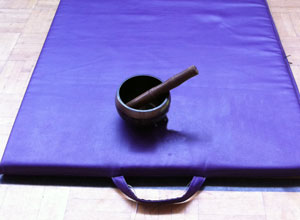
    Explore Music in Yoga - Try a Singing Bowl
  • Handling physical objects – Teaching the handling of age appropriate toys, props and musical instruments.  Kids Yoga:  Introducing a Singing Bowl during class is a fun way for children learn to play it, while the other children watch and learn how to play and listen for the sound of the bowl singing.
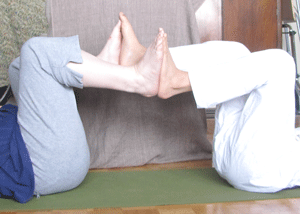
  • Interacting with others – Teaching singing, dancing, game playing  and partner yoga.  Kids Yoga:  consider partner yoga bicycle legs (see picture).  For toddlers try adult/child partner yoga, with the adult moving a child’s legs like they are riding a bicycle.  Then switch and let the toddlers grab the adult’s feet while they slowly bicycle.
    Partner Yoga - Bicycle Legs
In the Young Yoga Masters kids yoga teacher training we emphasize choosing postures and activities appropriate for the age group. Remember for toddlers merely standing up is a balancing posture.

Exploring Develops Confidence

When kids Explore they not only develop problem solving skills and motor skills they also develop emotional strength in the face of hardship. Kids faced with a hard task or a complex movement will struggle and learn to deal with struggling.
Kids’ yoga teachers need to be keenly aware that stress can be devastating for children; nevertheless, they shouldn’t be too quick to help a struggling child. Struggle in the right doses helps kids go from not being able to do something to being able to do it easily. We don’t want to deny kids this lesson as it is one they will benefit from for their entire lives. Ziggy Marley and Paul Simon explain it perfectly in song, “Walk tall, walk tall, even if you fall get up.”

Wednesday, July 20, 2011

The Presence of Mindfulness in Montessori: Sensorial


"The development of the senses indeed precedes that of superior intellectual activity and the child between three and seven years is in the period of formation. We can, then, help the development of the senses while they are in this period."  Maria Montessori - The Montessori Method, Chapter14

I may be stating the obvious when mindfulness is present in the Sensorial area in a Montessori environment. In the book Teaching Meditation to Children, by Fontana and Slack includes an exercise called Kim's Game.  This is a game that is suitable for young  children and very fun to play during your Parent Meetings. What you will need is various objects such as a pencil, spoon, cup, apple, flower, etc. placed on a tray. Place the objects on a tray and cover with a piece of fabric or towel. With a small group of children show them the materials for a limited time. The more objects on the tray, the more time. Cover the tray. The children will then tell or write down as many materials they can remember. After a few attemps, they will improve rapidly. 

The sensorial materials were created to help children in the process of creating and organizing their intelligence. Montessori scientifically designed materials that isolate a quality found in the world such as color, size and shape. The child, through repeated manipulation of these objects, comes to form clear ideas, abstractions and provokes "auto-education". What could not be explained by words, the child learns by experience working with these self correcting sensorial materials. The Sensorial materials are esthetically pleasing and attracts a child with ease. They aid a child in a better understanding of his environment and given the knowledge not by "words" but by his experiences. It includes using the child's hands, senses, and spontaneous activity.

Montessori writes that Sensorial materials are more like "games" where it gathers children to take turns in guessing. "Sometimes the children spontaneously make use of the blindfold, taking turns, and interspersing the work with peals of joyful laughter." Montessori, The Montessori Method p. 187

Isolation of the Senses with Sensorial Materials
Visual: Montessori broke the visual sense down into separate sections.
·       Dimension (size of the object): Montessori Materials are the Pink Tower, Brown Stair, Red Rods, Knobbed Cylinders, and Knobless Cylinders.
·       Color/chromatic (awareness of color): Montessori Materials are the Color Box 1, Color Box 2 and Color Box 3.
·       Form (awareness of shapes): Montessori Materials are the Geometric Solids, Geometry Cabinet, Binomial Cube, Trinomial Cube, and Constructive Triangles.
Auditory: Sound Cylinders and Bells.
Tactile: Montessori broke tactile in four areas:
  • Surface touch: Touch boards, Touch tablets
             and Fabrics.
  • Stereognostic (whole form, volume): Geometric Solids, Sorting Trays, Mystery Bag.
  • Thermic (temperatures): Thermic Tablets and Thermic Bottles.
  • Baric (differences in weights): Baric Tablets
Olfactory (smell): Smelling Bottles
Gustatory (taste): Tasting Bottles

Monday, July 18, 2011

Montessori Mocha Scrub

Welcome Articulate Vermiculate!  This is a wonderful blog of a family and their experiences of growing a garden. It is witty, fun and has great ideas for all of you Montessori gardeners out there. Below is Carrie's recipe for a Mocha Spice Sugar Scrub. It was a perfect gift her Montessori toddlers made for Mother's Day, how about making it a gift for yourself.

Visit: http://articulatevermiculate.blogspot.com

Recipe #1: Mocha Spice Sugar Scrub

The kids in my toddler class at school made this for their mommies for Mother's Day. The toddlers helped to grind the coffee using an "old-fashioned" hand crank grinder I purchased at a consignment shop as well as the nutmeg with a little grinder from the Montessori Services Catalogue.

Your own preparation does not need to be so complex. You should have all of these ingredient in your kitchen cabinets. Otherwise, they can be easily purchased at the grocery store. Remember, that you'll need to use the scrub within a week or so of making it.

Ingredients:

1 cup of sugar
1 tablespoon ground coffee
1 tablespoon cocoa powder
1 teaspoon cinnamon
1 generous pinch ginger
1 generous pinch nutmeg
1/4 to 1/2 cup cold press light smelling oil such a jojoba, almond, grape seed, or safflower (which we used)
                 *note: safflower, grape seed, and almond oil will be found with the COOKING oils not in the beauty section. jojoba can be found at health food stores and herb shops. Olive oil could be used, but the smell isn't really that great with coffee*

Mix dry ingredients thoroughly.  Add the oil slowly until your desired consistency is reached.

Use the scrub before you shower (with or without a loofah, depending on how much exfoliation you want). Beware of slippery bath tubs and shower stalls. If you feel sticky after your shower, wash lightly with soap.

ENJOY!

Sunday, July 17, 2011

Preparing the Environment at My Kitchen Table

This time of year always finds me in vacation/work mode. It means that the sewing machine has reached the kitchen table. You know what I mean, it is when all of your Montessori books, albums, materials, projects are out and clearing the table for meals becomes a project in itself. I have not stepped foot into my classroom in six weeks, but somehow it does not leave me.
My adventurous task this week is to finish sewing 4 aprons for our food prep works. I chose a pattern that is versatile and could be used with apple slicing to peeling carrots. There are a numerous apron pattern designs and I found the free child apron pattern from Sew Liberated to be most beneficial. A very young Primary child can independently put this on with ease without it getting twisted and bunched up. I am also working on sewing a few threefold pockets to be used for the solid, thick and thin cards for the Geometry and Botany cabinet.

Others things that have been prepared on my kitchen table in the past week are my Parent Orientation notes, Cultural Plan, Record Keeping and the beginnings of a new Land, Air and Water mat.

Don't forget to take time out for yourself.  I have yoga planned for my Monday morning.
Sew Liberated Sewing Child Apron Pattern: http://sewliberated.typepad.com/sew_liberated/2009/01/childs-apron-pattern-and-other-free-tutorials.html

Friday, July 8, 2011

Child of the Week - Beginning With Inner Peace


I find myself realizing that my journey of nurturing my own spirit and nurturing the children will coincide. I don't know about you but the beginning of the school year "itch" has already begun. I always find myself planning the cultural scheme first. In the first month of school I also plan lessons that will relate to the caring of themselves, the environment and each other. In Aline E. Wolf's, Nurturing the Spirit, she says "If children like adults, feel peace in their hearts, they can more easily relate peacefully to those around them." One of the lessons on building self love uses "Child of the Week" to acknowledge the importance of each of the child. This will allow the child to develop awareness of themselves, self worth, confidence and to be able to share with their peers. Wolf warns us about the "shallowness" of the questions, such as "What I watch on TV," or "What I want for presents." At this time I am complying a list of questions that would be suitable for a 3-6 year old to answer. It will include their name, birthday and the town and state in which they live in.

I like to be helpful by ___________.
I would like to learn about ________.
I find peace in __________________.

I would love for us as Montessorians to come together and brainstorm questions that will not be superficial. My goal is to help guide the children to an inner peace and spirit for themselves. In the next week I would love to have 10-12 questions and I look forward to sharing them with you.

Monday, July 4, 2011

Liberating

"To see the child as he is, is made difficult for us as adults on account of our own defects. Between us and the baptized child lies the gulf created by our own sins. Because of this defective vision the adult is generally to much occupied in looking for defective tendencies also in the child and seeking to correct them. We must first remove the beam from our own eyes, and then we shall see more clearly how to remove the mote in the child's. In the "removing of the beam from her own eyes" consists the spiritual training of the teacher." - Maria Montessori, Her Life and Work. (p.300-301)

The answers have always been in front of me. Some were simple, "What are you grateful for?" or "Who do you love?" and some were a little difficult "What is your biggest regret?" or "What was the toughest time in your life?"  for me to answer and just to say it out loud.  This activity was self-searching and brought an awareness to myself. But amazingly it was very liberating. The questions can be found in a previous post, A Montessori Teacher's Mask?.

Monday, June 27, 2011

A Montessori Teacher's Mask?

Do you put on a front to accept others? Do you pretend everything is perfect? Do you say things you don't mean? Do you accept yourself just the way that you are? Do you buy things you can't afford?

I just had one of those experiences the other day. I went out with my child to the local farmers market and after we decided to go to our favorite antique store. Knowingly we are going on vacation in a month, we made a family agreement not to make purchases of things we don't need. How am I setting an example to my child? Many thoughts were going through my mind. Apparently the mask went on as I went to the register to pay for the items. I was hoping the clerk did not see my face, hopefully hiding from my mask. As we went home that day, I did have to explain why that was not the best thing for mom to do. We all make mistakes sometimes...even moms and Montessori teachers.

In Nurturing the Spirit in Non-Sectarian Classrooms, by Aline Wolf, she talks about how "how we are all human beings, wounded in some way." We hide our "shadow side" from others and most of us wear an invisible mask. She states, "The mask is not our true self but is the way we want others to see us. Teacher's often wear the mask of perfection, never wanting to admit weakness to their students, when actually talking about their own flaws would make them accessible." (p.35)
"Mistakes bring us closer and make us better friends." - Maria Montessori (The Absorbent Mind, p.249)

Below are some questions you may want to ask yourself. I will be answering and sharing with you...some are a little tough. Please feel free to comment or add more additional information to Mindful Montessori. Follow me and cheer me on!

75 Questions to Ask Yourself

1. Why not me?
2. Am I nice?
3. Am I doing what I really want to do?
4. What am I grateful for?
5. What’s missing in my life?
6. Am I honest?
7. Do I listen to others?
8. Do I work hard?
9. Do I help others?
10. What do I need to change about myself?
11. Have I hurt others?
12. Do I complain?
13. What’s next for me?
14. Do I have fun?
15. Have I seized opportunities?
16. Do I care about others?
17. Do I spend enough time with my family?
18. Am I open-minded?
19. Have I seen enough of the world?
20. Do I judge others?
21. Do I take risks?
22. What is my purpose?
23. What is my biggest fear?
24. How can I conquer that fear?
25. Do I thank people enough?
26. Am I successful?
27. What am I ashamed of?
28. Do I annoy others?
29. What are my dreams?
30. Am I positive?
31. Am I negative?
32. Is there an afterlife?
33. Does everything happen for a reason?
34. What can I do to change the world?
35. What is the most foolish thing I’ve ever done?
36. Am I cheap?
37. Am I greedy?
38. Who do I love?
39. Who do I want to meet?
40. Where do I want to go?
41. What am I most proud of?
42. Do I care what others think about me?
43. What are my talents?
44. Do I utilize those talents?
45. What makes me happy?
46. What makes me sad?
47. What makes me angry?
48. Am I satisfied with my appearance?
49. Am I healthy?
50. What was the toughest time in my life?
51. What was the easiest time in my life?
52. Am I selfish?
53. What was the craziest thing I did?
54. What is the craziest thing I want to do?
55. Do I procrastinate?
56. What is my greatest regret?
57. What has had the greatest impact on my life?
58. Who has had the greatest impact on my life?
59. Do I stand up for myself?
60. Have I settled for mediocrity?
61. Do I hold grudges?
62. Do I read enough?
63. Do I listen to my heart?
64. Do I donate enough to the less fortunate?
65. Do I pray only when I want something?
66. Do I constantly dwell on the past?
67. Do I let other people’s negativity affect me?
68. Do I forgive myself?
69. When I help someone do I think “What’s in it for me”?
70. Am I aware that someone always has it worse than me?
71. Do I smile more than I frown?
72. Do I surround myself with good people?
73. Do I take time out for myself?
74. Do I ask enough questions?
75. What other questions do I have?

These questions are from: http://www.lyved.com

Sunday, June 26, 2011

A Young Chic's Montessori Journey of Becoming a Spiritual Aware Adult

I am in the beginning of Nurturing the Spirit as a Montessori teacher. With seven years under my belt I may still be considerd a young chic. I came upon Montessori as many Montessori teacher's do. I was a parent looking for a place for my child to be while I was at work.


With a suggestion from a friend, I observed the toddler Montessori classroom where my 2 year old would spend her days. It was in the most peaceful, caring and loving environment. As I continued with the tour, it amazed me. Teaching was always deep in my heart, but I was always yearned for something more...something that I believed would make some kind of difference in the world. As I was touring the Primary and Elementary environments, this is the place I knew my child and I had to be.


From that moment it all seemed to fall into place. The following year I was an assistant in the elementary classroom and learned many of the important aspects of the Montessori Philosophy such as Caring for the Environment, Order and Independence. That summer I began my training to become a Primary teacher. I then continued my independent study and began in my very own Primary class. Seven years later, I continue to be forever thankful for the Montessorians that have been around me to help guide and direct me on this journey.


At the end of each year, I take the time to reflect on the past year. What worked? What didn't? Do I need to change the environment? What will my goals be for the following year? What are the spiritual needs of the children? How will I implement these in the classroom? How will I prepare myself?


I have always wanted to expand my spirituality. Why not with the Montessori philosophy and children I work with. How do I begin? I began reading, Nurturing the Spirit in Non-Sectarian Classrooms, by Aline Wolf. This is an amazing guide for all Montessorians who want to be true to Montessori's philosophy, "Help me to help myself". This is a widely used Montessori quote. It is not only Practical Life skills, but more about guiding the spirit of the child. "We must help the child to act for himself, think for himself, this is the art of those who aspire to serve the spirit. It is the teacher's joy to welcome the manifestation of the spirit." - Maria Montessori, Education For A New World.


Below are some more links that may help you continue on your journey of nurturing the spirit within yourself and the children you guide.


Montessori Conferences:
www.montessori.org
www.amshq.org
www.montessori-ami.org


Mindful Blogs:
http://blog.beliefnet.com/mindfulnessmatters/

Please feel free to comment or add more additional information to Mindful Montessori. Follow me and cheer me on!

Friday, June 24, 2011

Mon"tea"sori Herbal Facial, Nurturing Your Spirit and Yourself

Stop sewing aprons, stop making 3 part cards and YES please put down The Absorbent Mind! Did I get your attention? Now I would like you to walk out to your garden and pick some Thyme, Peppermint and Lavender. If you do not have a garden I am sure you can find these herbs locally or in your neighbor's garden. (a little sarcasm) Below is a familiar "lesson" on how to give yourself a Monteassori Herbal Facial. It may fit nicely in your Montessori Philosopy, Botany or Practical Life album.

Monteasori Herbal Facial

Material:  A large pot with lid, water, dried or fresh herbs or essential oils and 2 large towels.

Preparation: Clean your face thoroughly and tie your hair back if needed.

Exercise: 

1. Boil a kettle or pot full of water then add the herbs and fruity ingredients (about 1/3 cup fresh or dried herbs and fruit slices per 4 cups of water). Boil for a minute or two then remove from heat. Cover and let steep for about 5 minutes.

2. Place pot on counter or table on top of a towel and remove lid. Cover your head with a another large clean towel and position your face over the steaming water (with the towel acting as a tent over the bowl to capture the steam).

3. Keep your eyes closed and your face at least 10 to 12 inches from the boiling water during the facial. Enjoy the fragrant steam and relax, but don’t overdo it–keep the facial time between 5 to 7 minutes.

4. Once the facial is over, splash face with slightly cool water and pat dry.

Points of Interest:
  1. Nurturing your Spirit
  2. Taking time for yourself
  3. Need I say more?
Control of Error: Yourself

Direct Aims:
  1. Order
  2. Sequencing
  3. Organization
  4.  Thinking
 Indirect Aims:
  1. Relaxing
  2. Furthering use of herbs
  3. Observing which combinations you like.
Ages: 20 and something years.

Variations:
  1. Spearmint, Lemon Balm, Lemon or Orange Slices
  2. Chamomile, Rosemary, Peppermint
  3. Green Tea, Rose Petals, Chamomile
  4. Rosemary, Lemon, Honey
  5. Lemon Slices, Peppermint
  6. Lemon balm, Lavender
  7. Chamomile, Fennel Seeds, Rose Petals
  8. Thyme, Peppermint, Lavender
  9. Parsley, Lavender, Lemon balm
  10. Sage, Lavender, Rosemary, Thyme
  11. Cinnamon, Orange Slices
  12. Peppermint, Cloves, Rosemary

Tuesday, June 21, 2011

Summer Solstice, A New Season


Happy Summer Solstice!


My Mindful Montessori summer plan is going well so far. I have started my yoga routine. Yesterday was my first class in about two weeks. My body is sore! To keep myself going I have made the commitment to go two more times this week. Above is a video on how to do one of my favorite yoga poses...Sun Salutation in honor of the first day of summer.

Meditation has been the most difficult thing for me do. Finding a place where you can have no interruptions may be difficult. My favorite place is on my back deck surrounded by beautiful large trees.  Meditation is the first thing I have to do in the morning, even before I have my coffee.  I find myself wanting to keep my eyes closed but I have read to keep them open and looking downward. I have started with ten minutes and I hope to move to 15 minutes by the end of next week.

I continue to wait for a couple of my books that I have ordered. I am looking forward to future posts. What does all this have to do with Mindful Montessori?... the teacher must prepare herself.  Please leave comments. I would love to hear from you!

Saturday, June 18, 2011

Mindfulness Meditation

How to do Mindfulness Meditation

By “Mindfulness practice is simple and completely feasible. Just by sitting and doing nothing, we are doing a tremendous amount.”


In mindfulness, or shamatha, meditation, we are trying to achieve a mind that is stable and calm. What we begin to discover is that this calmness or harmony is a natural aspect of the mind. Through mindfulness practice we are just developing and strengthening it, and eventually we are able to remain peacefully in our mind without struggling. Our mind naturally feels content.

An important point is that when we are in a mindful state, there is still intelligence. It’s not as if we blank out. Sometimes people think that a person who is in deep meditation doesn’t know what’s going on—that it’s like being asleep. In fact, there are meditative states where you deny sense perceptions their function, but this is not the accomplishment of shamatha practice.


Creating a Favorable Environment

There are certain conditions that are helpful for the practice of mindfulness. When we create the right environment it’s easier to practice.

It is good if the place where you meditate, even if it’s only a small space in your apartment, has a feeling of upliftedness and sacredness. It is also said that you should meditate in a place that is not too noisy or disturbing, and you should not be in a situation where your mind is going to be easily provoked into anger or jealousy or other emotions. If you are disturbed or irritated, then your practice is going to be affected.


Beginning the Practice

I encourage people to meditate frequently but for short periods of time—ten, fifteen, or twenty minutes. If you force it too much the practice can take on too much of a personality, and training the mind should be very, very simple. So you could meditate for ten minutes in the morning and ten minutes in the evening, and during that time you are really working with the mind. Then you just stop, get up, and go.

Often we just plop ourselves down to meditate and just let the mind take us wherever it may. We have to create a personal sense of discipline. When we sit down, we can remind ourselves: “I’m here to work on my mind. I’m here to train my mind.” It’s okay to say that to yourself when you sit down, literally. We need that kind of inspiration as we begin to practice.


Posture
The Buddhist approach is that the mind and body are connected. The energy flows better when the body is erect, and when it’s bent, the flow is changed and that directly affects your thought process. So there is a yoga of how to work with this. We’re not sitting up straight because we’re trying to be good schoolchildren; our posture actually affects the mind.

People who need to use a chair for meditation should sit upright with their feet touching the ground. Those using a meditation cushion such as a zafu or gomden should find a comfortable position with legs crossed and hands resting palm-down on your thighs. The hips are neither rotated forward too much, which creates tension, nor tilted back so you start slouching. You should have a feeling of stability and strength.

When we sit down the first thing we need to do is to really inhabit our body—really have a sense of our body. Often we sort of prop ourselves up and pretend we’re practicing, but we can’t even feel our body; we can’t even feel where it is. Instead, we need to be right here. So when you begin a meditation session, you can spend some initial time settling into your posture. You can feel that your spine is being pulled up from the top of your head so your posture is elongated, and then settle.

The basic principle is to keep an upright, erect posture. You are in a solid situation: your shoulders are level, your hips are level, your spine is stacked up. You can visualize putting your bones in the right order and letting your flesh hang off that structure. We use this posture in order to remain relaxed and awake. The practice we’re doing is very precise: you should be very much awake even though you are calm. If you find yourself getting dull or hazy or falling asleep, you should check your posture.


Gaze

For strict mindfulness practice, the gaze should be downward focusing a couple of inches in front of your nose. The eyes are open but not staring; your gaze is soft. We are trying to reduce sensory input as much as we can. People say, “Shouldn’t we have a sense of the environment?” but that’s not our concern in this practice. We’re just trying to work with the mind and the more we raise our gaze, the more distracted we’re going to be. It’s as if you had an overhead light shining over the whole room, and all of a sudden you focus it down right in front of you. You are purposefully ignoring what is going on around you. You are putting the horse of mind in a smaller corral.


Breath
When we do shamatha practice, we become more and more familiar with our mind, and in particular we learn to recognize the movement of the mind, which we experience as thoughts. We do this by using an object of meditation to provide a contrast or counterpoint to what’s happening in our mind. As soon as we go off and start thinking about something, awareness of the object of meditation will bring us back. We could put a rock in front of us and use it to focus our mind, but using the breath as the object of meditation is particularly helpful because it relaxes us.

As you start the practice, you have a sense of your body and a sense of where you are, and then you begin to notice the breathing. The whole feeling of the breath is very important. The breath should not be forced, obviously; you are breathing naturally. The breath is going in and out, in and out. With each breath you become relaxed.


Thoughts

No matter what kind of thought comes up, you should say to yourself, “That may be a really important issue in my life, but right now is not the time to think about it. Now I’m practicing meditation.” It gets down to how honest we are, how true we can be to ourselves, during each session.

Everyone gets lost in thought sometimes. You might think, “I can’t believe I got so absorbed in something like that,” but try not to make it too personal. Just try to be as unbiased as possible. Mind will be wild and we have to recognize that. We can’t push ourselves. If we’re trying to be completely concept-free, with no discursiveness at all, it’s just not going to happen.

So through the labeling process, we simply see our discursiveness. We notice that we have been lost in thought, we mentally label it “thinking”—gently and without judgment—and we come back to the breath. When we have a thought—no matter how wild or bizarre it may be—we just let it go and come back to the breath, come back to the situation here.

Each meditation session is a journey of discovery to understand the basic truth of who we are. In the beginning the most important lesson of meditation is seeing the speed of the mind. But the meditation tradition says that mind doesn’t have to be this way: it just hasn’t been worked with.

What we are talking about is very practical. Mindfulness practice is simple and completely feasible. And because we are working with the mind that experiences life directly, just by sitting and doing nothing, we are doing a tremendous amount.


Sakyong Mipham Rinpoche is holder of the Buddhist and Shambhala lineages of Chögyam Trungpa Rinpoche. He has received teachings from many of the great Buddhist masters of this century, including Dilgo Khyentse Rinpoche, Penor Rinpoche and his father Trungpa Rinpoche. In 1995 he was recognized as the incarnation of the great nineteenth-century Buddhist teacher Mipham Rinpoche.

This article was originally published in the January 2000 issue of the Shambahala Sun, and is excerpted in our 30th-anniversary collection of the finest meditation teachings from the magazine, as printed in our January 2010 issue