Friday, August 5, 2011

Montessori Classroom Photographs: Language

Welcome to my Primary environment. This week I am sharing my photographs of the language area. Enjoy!


Writing Shelf, on the left is an object box for Sand Paper Sounds


Writing sequence, we teach cursive handwriting,


Above is the Waseca Reading Program (I love it!), below is language enrichment materials


Readers, Phonograms and Long Vowel


Grammar shelf: The Farm and grammar boxes. A fish tank goes on the top left.


Sunday, July 31, 2011

Creating Parent Community in Your Montessori Classroom


Science Fair
"Goodness must come out of reciprocal helpfulness, from the unity derived from spiritual cohesion."
 - Maria Montessori


In my very first post of my blog I shared my goals for the new school year. One goal was not included. It was to increase parent involvement in our Montessori classroom and community. This will allow all teachers, children and parents to create a sense of well being and to merge the relationships together. We have events throughout the year such as Harvest Day, Festival of Lights, National Montessori Week and Earth Day that all the families have an opportunity to participate in. This year I am hoping to have parents share themselves with the primary classroom. I recently emailed our families a "Happy New Year" email. This is a portion of What's New...

Parent Visit…At least once a month I would like to have a parent share their professions, skills, hobbies, talents, customs, or native languages.  Attached is our culture theme for the year. Think about it and I hope to have this commitment at Parent Orientation. There will be a sign up sheet at Parent Orientation.

Science Fair

Shortly after sending out the email, I am excited to already have two parents commit on Maria Montessori's birthday (Aug. 31) and our South America study. I sent my parents a cultural theme plan for the year to help spark some interest and ideas.

Another idea is to have parents come and read in your classroom. They may read stories or they can listen to your children read their "readers".

What are your ideas at your Montessori school? How are your parents involved?


Sunday, July 24, 2011

Spiritual Nurturers

This blog is not intended to deny anyone of any religion or spiritual journey you may be on. We are all on one. I teach in a non-sectarian Montessori school with the many religions and cultures in my very own classroom. I myself am on my own religious journey. You may be wondering, "What does she practice?",  "Does she attend church?" and/or  "Does she believe in God."  I believe those are very important questions to make a quick judgement of this blog, however it is not my intention at all. You may be Christian, Jewish, Atheist, Hindu, Buddist, Baha'i', Native American or believe in another religion. Welcome. Our common bond is we are all "spiritual nurturers".

What we do as Montessori teacher's is much larger than we can ever imagine. Our connection with all our children that we encounter is extremely precious.  Spirituality is and has always been present in our classrooms. You may have seen a child help another by picking up beans off the floor, reading to another child, giving a child a picture they just drew. A child may be sitting quietly outside in the garden. These are all aspects of spirituality. Some believe spirituality is present with the religion that they believe in. But as Montessorians in a non-sectarian school, we cannot "teach" a religion but may have to see "spirituality in a much broader sense" (Wolf, 16). It is everyday acts such as compassion, generosity, helpfulness, love, trust and more virtues we can share with the children. How do we show compassion? How are we generous? I am helpful to others by....., I show love when....

"The greatest challenge we all face as spiritual nurturers is to become attuned to the young child's authentic spirituality, which unlike our own - is still such an integrated part of life...Children's exuberant spirituality is reflected in everything they do...A child shows us the extraordinary in the ordinary." (Wolf/Fitzpatrick, p.29)

Quotations from:
Nurturing the Spirits in Non-Sectarian Classrooms,  Aline D. Wolf

Thursday, July 21, 2011

Exploring Kids Brains On Yoga

In our mother’s womb, sixteen weeks after conception, our brains start receiving signals from our ears. This experience of sound begins a life long bombardment of stimulation from the senses to the brain. When we are thrust into the light of day our baby brains are flooded with all the senses: sounds, sights, smells, tastes and touch.
Our baby brains begin organizing neurons to understand this onslaught of sensation. Making sense of our senses becomes a life long project we undergo as infants, toddlers, kids and eventually  as yoga teachers.
As we age we experience ourselves as a “self” exploring a physical world; a self that faces the ultimate questions of life. Who am I? Where am I? What can I do? Modern brain scanning techniques reveal our brains take a starring role in our exploration of the world.  These brain scans also reveal Exploring builds better brains.

Three Ways to Encourage Exploring with Kids Yoga

Kids engage in exploring when they interact with their environment in new and novel ways that pushes their physical, mental and emotional boundaries. Through exploration kids push their brains to develop new connections and learn new skills.
You can foster healthy brain development by providing good exploring activities for kids:
  • Moving the body –  Teaching big movements that involve the entire body and small movements that involve just parts of the body.  Kids Yoga: try a rocket ship launch – start in a squat position and use your fingers to do a countdown from ten to one (small movements) then stand up slowly like a rocket ship launching and flying to the moon (large movements).
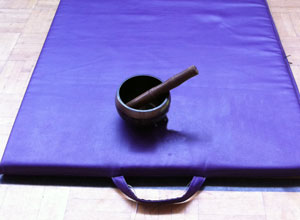
    Explore Music in Yoga - Try a Singing Bowl
  • Handling physical objects – Teaching the handling of age appropriate toys, props and musical instruments.  Kids Yoga:  Introducing a Singing Bowl during class is a fun way for children learn to play it, while the other children watch and learn how to play and listen for the sound of the bowl singing.
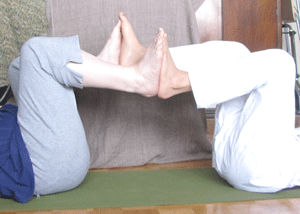
  • Interacting with others – Teaching singing, dancing, game playing  and partner yoga.  Kids Yoga:  consider partner yoga bicycle legs (see picture).  For toddlers try adult/child partner yoga, with the adult moving a child’s legs like they are riding a bicycle.  Then switch and let the toddlers grab the adult’s feet while they slowly bicycle.
    Partner Yoga - Bicycle Legs
In the Young Yoga Masters kids yoga teacher training we emphasize choosing postures and activities appropriate for the age group. Remember for toddlers merely standing up is a balancing posture.

Exploring Develops Confidence

When kids Explore they not only develop problem solving skills and motor skills they also develop emotional strength in the face of hardship. Kids faced with a hard task or a complex movement will struggle and learn to deal with struggling.
Kids’ yoga teachers need to be keenly aware that stress can be devastating for children; nevertheless, they shouldn’t be too quick to help a struggling child. Struggle in the right doses helps kids go from not being able to do something to being able to do it easily. We don’t want to deny kids this lesson as it is one they will benefit from for their entire lives. Ziggy Marley and Paul Simon explain it perfectly in song, “Walk tall, walk tall, even if you fall get up.”

Wednesday, July 20, 2011

The Presence of Mindfulness in Montessori: Sensorial


"The development of the senses indeed precedes that of superior intellectual activity and the child between three and seven years is in the period of formation. We can, then, help the development of the senses while they are in this period."  Maria Montessori - The Montessori Method, Chapter14

I may be stating the obvious when mindfulness is present in the Sensorial area in a Montessori environment. In the book Teaching Meditation to Children, by Fontana and Slack includes an exercise called Kim's Game.  This is a game that is suitable for young  children and very fun to play during your Parent Meetings. What you will need is various objects such as a pencil, spoon, cup, apple, flower, etc. placed on a tray. Place the objects on a tray and cover with a piece of fabric or towel. With a small group of children show them the materials for a limited time. The more objects on the tray, the more time. Cover the tray. The children will then tell or write down as many materials they can remember. After a few attemps, they will improve rapidly. 

The sensorial materials were created to help children in the process of creating and organizing their intelligence. Montessori scientifically designed materials that isolate a quality found in the world such as color, size and shape. The child, through repeated manipulation of these objects, comes to form clear ideas, abstractions and provokes "auto-education". What could not be explained by words, the child learns by experience working with these self correcting sensorial materials. The Sensorial materials are esthetically pleasing and attracts a child with ease. They aid a child in a better understanding of his environment and given the knowledge not by "words" but by his experiences. It includes using the child's hands, senses, and spontaneous activity.

Montessori writes that Sensorial materials are more like "games" where it gathers children to take turns in guessing. "Sometimes the children spontaneously make use of the blindfold, taking turns, and interspersing the work with peals of joyful laughter." Montessori, The Montessori Method p. 187

Isolation of the Senses with Sensorial Materials
Visual: Montessori broke the visual sense down into separate sections.
·       Dimension (size of the object): Montessori Materials are the Pink Tower, Brown Stair, Red Rods, Knobbed Cylinders, and Knobless Cylinders.
·       Color/chromatic (awareness of color): Montessori Materials are the Color Box 1, Color Box 2 and Color Box 3.
·       Form (awareness of shapes): Montessori Materials are the Geometric Solids, Geometry Cabinet, Binomial Cube, Trinomial Cube, and Constructive Triangles.
Auditory: Sound Cylinders and Bells.
Tactile: Montessori broke tactile in four areas:
  • Surface touch: Touch boards, Touch tablets
             and Fabrics.
  • Stereognostic (whole form, volume): Geometric Solids, Sorting Trays, Mystery Bag.
  • Thermic (temperatures): Thermic Tablets and Thermic Bottles.
  • Baric (differences in weights): Baric Tablets
Olfactory (smell): Smelling Bottles
Gustatory (taste): Tasting Bottles