Showing posts with label nurturing the spirit. Show all posts

Monday, September 5, 2011

Grace and Courtesy Lessons

In the Montessori classroom Grace and Courtey lessons are continous. These lesson allow the children to become aware and mindful of what they are doing in the classroom. For example, I may say "I am closing the door quietly." or " I am walking slowly in the classroom."

Everyday kindness and courtesy are vital practical life skills. Lessons in Grace and Courtesy teach everyday social customs, such as how to enter a room, not to disturb another’s work, how to ask if you may join in an activity and how to graciously decline an invitation, table manners, and how to offer an apology.

"We must help the child to act for himself, will for himself, think for himself; this is the art of those who aspire to serve the spirit. It is the teacher's joy to welcome the manifestation of the spirit." 

This year at our school, we are having a new monthly parent gathering called Montessori & Munchies. Within the 1 hour, teachers have prepared a Montessori topic that will lead into a group discussion. In August the topic was Grace and Courtesy lessons. Below I would like to share few lessons my collages put together for Toddler to Elementary.
- Maria Montessori 

Toddler
Eating Habits
  • Using s fork and spoon correctly
  • Chewing food with mouth closed
  • Sitting quietly in chair during a meal
Toilet Training
  • How and when to go to the bathroom
Proper Hygiene
  • How to wash hands
  • How to blow your nose
Manners
  • How to say "please" and "thank you"

Primary

Social Skills
  • How to greet people
  • How to shake hands when greeting someone
Manners
  • How to excuse oneself when walking in front of someone
  • How to interrupt when necessary
  • How to hand objects to another person, especially sharps objects like scissors and knives
  • How to say "please" and "thank you"
  • How to care for a pet
  • How to water a plant
  • How to clean up a spill
  • How to open and close a door quietly
  • How to pick up and carry a chair

Elementary

Social Skills
  • How to work with another person
  • How to resolve conflict
  • How to mediate between friends
  • How to help a younger friend

Manners
  • Writing a thank you note
  • Speaking politely to friends, family and teachers
  • Being kind to others

Environment
  • How to care for plants and animals
  • Setting up a table for a meal
  • How to clean and straighten a classroom or home
  • How to serve in the community
  • Caring for the earth

Kids Top Five Yoga Exercises

5 Sure-Fire Kids Yoga Exercises


Washing Machine: This is a great Kundalini Yoga warm-up that kids love because it is active and fun! In easy pose put your hands on your shoulders (fingers in front, thumbs in back). Then twist left and right like a washing machine. You can do breathing – inhaling as you go left and exhaling as you go right, but it’s also fun to say “swish, swish” as you go to each side. (Bonus Pose: Follow this one up with Dryer Pose where you rotate your hands around each other in front of your chest – said to be great for co-ordination and the brain)

Bicycle: In yoga we do bicycle lying on the back and pedaling our legs in the air (see picture). Finish by pedalling up a hill then going down the hill holding your legs stretched wide by your head and shout, “weeeeeeeeee!” (you don’t need to peddle down a hill!)  
Tricky Tree: A favorite in the partner yoga genre. In tree pose, both partners face forward and balance on one foot. Instead of putting your foot on your own leg, stretch it towards your partner and let them hold it up for you. One person holds a foot in front and the other person holds the foot behind their leg. You kind of look like a capital “H” when you do it. It is very tricky for pre-schoolers so you may need to help them balance in this one.  
Human Teacher Puppet: Want to get everyone’s attention in a class? Let one child sit on your lap and pretend they are teaching the class. Gently hold their wrists and move their arms around for them in a very animated way as you describe the next pose. Use different voices and accents, try hand gestures like using their hand to scratch their head or blow kisses. This is so popular the kids may start to jump on your lap the moment you sit down – so develop some kind of system to keep track of which kids have had a turn.

The Worry Tree: This is a beautiful image we use for relaxing. We have an imagination session for relaxation and go to different places in our imagination. At the beginning of the session we put all our worries on a big tree we call The Worry Tree. You put all the worries you can think of on there and when you are done then you start your imagination session. This is another one kids will ask for at the beginning of the class.
 
Aruna Humphrys
www.YoungYogaMasters.com

Sunday, July 31, 2011

Creating Parent Community in Your Montessori Classroom


Science Fair
"Goodness must come out of reciprocal helpfulness, from the unity derived from spiritual cohesion."
 - Maria Montessori


In my very first post of my blog I shared my goals for the new school year. One goal was not included. It was to increase parent involvement in our Montessori classroom and community. This will allow all teachers, children and parents to create a sense of well being and to merge the relationships together. We have events throughout the year such as Harvest Day, Festival of Lights, National Montessori Week and Earth Day that all the families have an opportunity to participate in. This year I am hoping to have parents share themselves with the primary classroom. I recently emailed our families a "Happy New Year" email. This is a portion of What's New...

Parent Visit…At least once a month I would like to have a parent share their professions, skills, hobbies, talents, customs, or native languages.  Attached is our culture theme for the year. Think about it and I hope to have this commitment at Parent Orientation. There will be a sign up sheet at Parent Orientation.

Science Fair

Shortly after sending out the email, I am excited to already have two parents commit on Maria Montessori's birthday (Aug. 31) and our South America study. I sent my parents a cultural theme plan for the year to help spark some interest and ideas.

Another idea is to have parents come and read in your classroom. They may read stories or they can listen to your children read their "readers".

What are your ideas at your Montessori school? How are your parents involved?


Sunday, July 24, 2011

Spiritual Nurturers

This blog is not intended to deny anyone of any religion or spiritual journey you may be on. We are all on one. I teach in a non-sectarian Montessori school with the many religions and cultures in my very own classroom. I myself am on my own religious journey. You may be wondering, "What does she practice?",  "Does she attend church?" and/or  "Does she believe in God."  I believe those are very important questions to make a quick judgement of this blog, however it is not my intention at all. You may be Christian, Jewish, Atheist, Hindu, Buddist, Baha'i', Native American or believe in another religion. Welcome. Our common bond is we are all "spiritual nurturers".

What we do as Montessori teacher's is much larger than we can ever imagine. Our connection with all our children that we encounter is extremely precious.  Spirituality is and has always been present in our classrooms. You may have seen a child help another by picking up beans off the floor, reading to another child, giving a child a picture they just drew. A child may be sitting quietly outside in the garden. These are all aspects of spirituality. Some believe spirituality is present with the religion that they believe in. But as Montessorians in a non-sectarian school, we cannot "teach" a religion but may have to see "spirituality in a much broader sense" (Wolf, 16). It is everyday acts such as compassion, generosity, helpfulness, love, trust and more virtues we can share with the children. How do we show compassion? How are we generous? I am helpful to others by....., I show love when....

"The greatest challenge we all face as spiritual nurturers is to become attuned to the young child's authentic spirituality, which unlike our own - is still such an integrated part of life...Children's exuberant spirituality is reflected in everything they do...A child shows us the extraordinary in the ordinary." (Wolf/Fitzpatrick, p.29)

Quotations from:
Nurturing the Spirits in Non-Sectarian Classrooms,  Aline D. Wolf

Thursday, July 21, 2011

Exploring Kids Brains On Yoga

In our mother’s womb, sixteen weeks after conception, our brains start receiving signals from our ears. This experience of sound begins a life long bombardment of stimulation from the senses to the brain. When we are thrust into the light of day our baby brains are flooded with all the senses: sounds, sights, smells, tastes and touch.
Our baby brains begin organizing neurons to understand this onslaught of sensation. Making sense of our senses becomes a life long project we undergo as infants, toddlers, kids and eventually  as yoga teachers.
As we age we experience ourselves as a “self” exploring a physical world; a self that faces the ultimate questions of life. Who am I? Where am I? What can I do? Modern brain scanning techniques reveal our brains take a starring role in our exploration of the world.  These brain scans also reveal Exploring builds better brains.

Three Ways to Encourage Exploring with Kids Yoga

Kids engage in exploring when they interact with their environment in new and novel ways that pushes their physical, mental and emotional boundaries. Through exploration kids push their brains to develop new connections and learn new skills.
You can foster healthy brain development by providing good exploring activities for kids:
  • Moving the body –  Teaching big movements that involve the entire body and small movements that involve just parts of the body.  Kids Yoga: try a rocket ship launch – start in a squat position and use your fingers to do a countdown from ten to one (small movements) then stand up slowly like a rocket ship launching and flying to the moon (large movements).
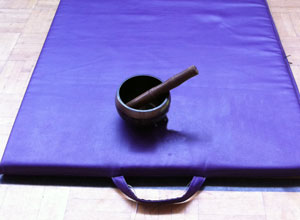
    Explore Music in Yoga - Try a Singing Bowl
  • Handling physical objects – Teaching the handling of age appropriate toys, props and musical instruments.  Kids Yoga:  Introducing a Singing Bowl during class is a fun way for children learn to play it, while the other children watch and learn how to play and listen for the sound of the bowl singing.
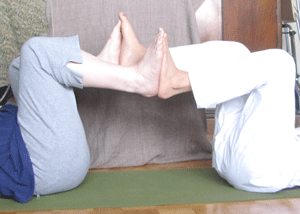
  • Interacting with others – Teaching singing, dancing, game playing  and partner yoga.  Kids Yoga:  consider partner yoga bicycle legs (see picture).  For toddlers try adult/child partner yoga, with the adult moving a child’s legs like they are riding a bicycle.  Then switch and let the toddlers grab the adult’s feet while they slowly bicycle.
    Partner Yoga - Bicycle Legs
In the Young Yoga Masters kids yoga teacher training we emphasize choosing postures and activities appropriate for the age group. Remember for toddlers merely standing up is a balancing posture.

Exploring Develops Confidence

When kids Explore they not only develop problem solving skills and motor skills they also develop emotional strength in the face of hardship. Kids faced with a hard task or a complex movement will struggle and learn to deal with struggling.
Kids’ yoga teachers need to be keenly aware that stress can be devastating for children; nevertheless, they shouldn’t be too quick to help a struggling child. Struggle in the right doses helps kids go from not being able to do something to being able to do it easily. We don’t want to deny kids this lesson as it is one they will benefit from for their entire lives. Ziggy Marley and Paul Simon explain it perfectly in song, “Walk tall, walk tall, even if you fall get up.”

Monday, July 18, 2011

Montessori Mocha Scrub

Welcome Articulate Vermiculate!  This is a wonderful blog of a family and their experiences of growing a garden. It is witty, fun and has great ideas for all of you Montessori gardeners out there. Below is Carrie's recipe for a Mocha Spice Sugar Scrub. It was a perfect gift her Montessori toddlers made for Mother's Day, how about making it a gift for yourself.

Visit: http://articulatevermiculate.blogspot.com

Recipe #1: Mocha Spice Sugar Scrub

The kids in my toddler class at school made this for their mommies for Mother's Day. The toddlers helped to grind the coffee using an "old-fashioned" hand crank grinder I purchased at a consignment shop as well as the nutmeg with a little grinder from the Montessori Services Catalogue.

Your own preparation does not need to be so complex. You should have all of these ingredient in your kitchen cabinets. Otherwise, they can be easily purchased at the grocery store. Remember, that you'll need to use the scrub within a week or so of making it.

Ingredients:

1 cup of sugar
1 tablespoon ground coffee
1 tablespoon cocoa powder
1 teaspoon cinnamon
1 generous pinch ginger
1 generous pinch nutmeg
1/4 to 1/2 cup cold press light smelling oil such a jojoba, almond, grape seed, or safflower (which we used)
                 *note: safflower, grape seed, and almond oil will be found with the COOKING oils not in the beauty section. jojoba can be found at health food stores and herb shops. Olive oil could be used, but the smell isn't really that great with coffee*

Mix dry ingredients thoroughly.  Add the oil slowly until your desired consistency is reached.

Use the scrub before you shower (with or without a loofah, depending on how much exfoliation you want). Beware of slippery bath tubs and shower stalls. If you feel sticky after your shower, wash lightly with soap.

ENJOY!

Thursday, July 14, 2011

Child of the Week: Montessori Lesson Plan

Child of the Week

Materials:  
Poster board
Photographs
Pictures or drawings
Art Supplies (crayons, markers, colored pencils, paint, etc.)
Preparation:
This is a lesson that will be done at home with their families the week before their assigned date.  The teacher will give the parents instructions and questions two weeks before their assigned date.  On Monday, the child will bring in their poster.
Exercise:
1.       The child will tell the class about themselves and read or the teacher will assist them.
2.       The child will share photographs and pictures.
3.       The child may also share a favorite book or share their     favorite thing.
Points of Interest:
1.       Spending time with parents
2.       Art
3.       Looking at photographs
Direct Aims:
1.       Order
2.       Sequence
3.       Following directions
4.       Thinking
5.       Organization
Indirect Aims:
1.       Awareness of Self
2.       Nurturing the Spirit
3.       Confidence
4.       Able to share with peers
Control of Error:
Parents and Teacher
Ages:
3-6
Variations:
The children can make a booklet form and share a story about themselves. They can bring in something to share (excluding toys), something they made (food or art) or their pet.

Parent Instructions:  Sample
Hello Mr. and Mrs. Smith,
Next week Kate is going to be the “Child of the Week”. We would like for you to help her answer questions about herself, include a photograph and create a poster board display. She will be sharing this with her class on Monday. Be creative and take your time.
Have Fun,
Mrs. Wilson
Free Printable Giveaway!!!!
Follow Mindful Montessori and you will receive the “Child of the Week” questionnaire...Montessori style. If you already follow, comment below and I will be happy to send it to you.

Wednesday, July 13, 2011

Please Excuse My Appearance

Today I came back from a three day trip with my daughter to a cabin on a lake. We had a wonderful time where we enjoyed the simplicities of summer...swimming, canoeing, fishing and the warm summer sun. As we pulled in the driveway, I checked the mailbox... I have a new book called: How To Train a Wild Elephant & Other Adventures in Mindfulness, by Jan Chozen Bayes, MD.

A vacation after a vacation is always advised; I found a comfortable place hoping this new book will entertain me. It did. Included in this book are simply daily mindfulness practices. My first exercise: Use your nondominant hand. I will be using my nondominant hand to do my ordinary daily tasks such as brushing my hair, brushing my teeth and eating my meals. I would tell you more, but the book advises me to stop reading and read later this week. Try it! I think this might be fun.

How is my typing by the way?

Saturday, July 9, 2011

Freeze Up! Warm Up!

This is a great lesson from http://alluemkids.blogspot.com. This is a great blog with great lessons to give your children. Some of the lessons also include a follow-up activity. Below is an example...Others include The Balloon Ride and What's That Feeling.

Freeze Up! Warm Up!

Each day is made up of different situations - good and bad. And just like yoga poses, some situations may be difficult causing us to freeze up or want to get out, while other situations (or poses) makes us feel good and relaxed. Being in new places or meeting new people may make us feel so shy we don't know what to do or say. Being in the dark or in deep water may make us feel so scared that we panic. All of that is okay. It's important to notice what makes us "Freeze Up", so we can learn how to handle those situations and learn how to "Warm up!"
On a hot day on the patio by the river, the Alluem Kids stuck their hands in a bowl of ice. Why? To cool them off, sure, but to also teach them a lesson about letting go of stress and maybe even how to deal with the people, places, and things that cause stress. They were encouraged to hold the ice for at least 30 seconds, but knew that if it became too much, they should listen to their bodies and put it down. After holding the ice cubes, it was interesting to see the way each child dealt with the cold sting. Some said, eh, no problem and dealt with it. Some screeched and wanted out after 15 seconds (which of course, I reminded them they could put the ice down at anytime!). Some felt the cold for the 30 seconds and then threw the cube back in the bowl, immediately caring for the cold hand - holding it with the warm hand or wrapping it in a towel. After putting as many feeling words as possible to how our hands felt, we realized that everyone deals with stressors differently.
At times when we "Freeze Up" (like our ice cold hands), we might forget that we can in fact make ourselves "Warm Up" and be the ones to care for our bodies and minds. Some may instinctually react and self soothe, but for some we may need a gentle reminder. Making a list (writing or drawing) of things that freeze us up (things that make us feel bad or scared) right next to the things that warm us up (things that make us feel happy or loved) serves as a great visual to help us through those "Freeze Up" moments. And seeing or thinking of those things that help us "Warm Up" is always a good way to keep us happy and healthy!

Friday, July 8, 2011

Child of the Week - Beginning With Inner Peace


I find myself realizing that my journey of nurturing my own spirit and nurturing the children will coincide. I don't know about you but the beginning of the school year "itch" has already begun. I always find myself planning the cultural scheme first. In the first month of school I also plan lessons that will relate to the caring of themselves, the environment and each other. In Aline E. Wolf's, Nurturing the Spirit, she says "If children like adults, feel peace in their hearts, they can more easily relate peacefully to those around them." One of the lessons on building self love uses "Child of the Week" to acknowledge the importance of each of the child. This will allow the child to develop awareness of themselves, self worth, confidence and to be able to share with their peers. Wolf warns us about the "shallowness" of the questions, such as "What I watch on TV," or "What I want for presents." At this time I am complying a list of questions that would be suitable for a 3-6 year old to answer. It will include their name, birthday and the town and state in which they live in.

I like to be helpful by ___________.
I would like to learn about ________.
I find peace in __________________.

I would love for us as Montessorians to come together and brainstorm questions that will not be superficial. My goal is to help guide the children to an inner peace and spirit for themselves. In the next week I would love to have 10-12 questions and I look forward to sharing them with you.

Thursday, July 7, 2011

The Presence of Mindfulness in Montessori: Concentration

Concentrated attention is present in both Montessori education and mindfulness practices. In a recent activity in Shining Through, A Teachers' Handbook on Transformation, by Sonnie McFarland, it lead me to practice the development of our powers of concentration. It is an exercise that has allowed me to focus on the present moment and to create greater control of my  thoughts. Just as we the Montessori teachers would want to have our rhythm of life respected, we must respect the child in the moment. In Maria Montessori: Her Life and Work, by E.M. Standing, Montessori shares a story of how she was observing a child. The child was working on composing numbers 1-100 and Montessori felt it was dreadfully slow, she decided to help her only to find the little girl to tell her to leave her alone. "I felt justly rebuked," said Montessori, "for my stupidity. I had made the mistake of thinking the child's interest lay in getting to the end of the process and not in the process itself." Practicing to be mindful will allow us as Montessori teachers to allow ourselves to be present in the moment with our thoughts, emotions as well as our actions.


Montessori education has been an over 100 year-old-system that naturally incorporates mindfulness practices and the natural development of concentration. Concentration is highly valued in a Montessori classroom. When concentration is present in the environment, it is the Montessori teacher’s responsibility to protect it. A Montessori teacher acknowledges that this is a healthy state of Normalization which is when a child is "being a contributing member of society". The Montessori teacher will observe the children as constructive and kind in their behavior, calm, intelligent, and expansive and bring out "extraordinary spiritual qualities." In Montessori's, Spontaneous Activity in Education: The Advanced Montessori Method, she writes, "After this phenomenon of concentration the children are really "new" children. It is as though a connection had been made with an inner power...and this brings about the construction of the personality."

A traditional Montessori environment has a 3 hour work cycle. In this cycle it is the goal for the child to have full absorption. This exists when the child is focused in interesting and absorbing work and is consistent with the practice of mindful training of a child's attention. But don't be fooled if you ever enter or experience what Montessori calls "false fatigue". A phenomenon observed in Children’s Houses around the world, often at approximately 10 a.m. The children seem to lose interest in work, behavior becomes disorderly, and the noise level rises. It may appear as if the children are tired. Remind yourself that this is false fatigue and the children will go back to their work where there will be a higher level of concentration and focus.

An exercise from Shining Through, A Teacher's Handbook on Transformation, by Sonnie McFarland

Find a quiet spot where you will not be distracted by external noise. Sit in a chair or on a pillow on the floor with your back straight. Imagine a flow of energy traveling freely up your spinal column. Breathe deeply. Let your eyes close and pay attention only to your breath. Let it become gentle, even and smooth. Consciously relax your body. Release the tension you notice.

Now concentrate on a visual image that inspires you-a sound or a word. Whatever you choose, use it consistently. This image or sound serves as a point to focus for your mind. As you sit quietly, continue to concentrate on the sound and/or image and continue to keep your breathe deep, even and smooth. As thoughts arise in your consciousness, see them and let them go. Return to this point of concentration.

Continue to do this for 10-15 minutes at first, gradually expanding this time. Practicing concentration daily is extremely helpful in the development of your mind's creative capacity.

Monday, July 4, 2011

Liberating

"To see the child as he is, is made difficult for us as adults on account of our own defects. Between us and the baptized child lies the gulf created by our own sins. Because of this defective vision the adult is generally to much occupied in looking for defective tendencies also in the child and seeking to correct them. We must first remove the beam from our own eyes, and then we shall see more clearly how to remove the mote in the child's. In the "removing of the beam from her own eyes" consists the spiritual training of the teacher." - Maria Montessori, Her Life and Work. (p.300-301)

The answers have always been in front of me. Some were simple, "What are you grateful for?" or "Who do you love?" and some were a little difficult "What is your biggest regret?" or "What was the toughest time in your life?"  for me to answer and just to say it out loud.  This activity was self-searching and brought an awareness to myself. But amazingly it was very liberating. The questions can be found in a previous post, A Montessori Teacher's Mask?.

Monday, June 27, 2011

A Montessori Teacher's Mask?

Do you put on a front to accept others? Do you pretend everything is perfect? Do you say things you don't mean? Do you accept yourself just the way that you are? Do you buy things you can't afford?

I just had one of those experiences the other day. I went out with my child to the local farmers market and after we decided to go to our favorite antique store. Knowingly we are going on vacation in a month, we made a family agreement not to make purchases of things we don't need. How am I setting an example to my child? Many thoughts were going through my mind. Apparently the mask went on as I went to the register to pay for the items. I was hoping the clerk did not see my face, hopefully hiding from my mask. As we went home that day, I did have to explain why that was not the best thing for mom to do. We all make mistakes sometimes...even moms and Montessori teachers.

In Nurturing the Spirit in Non-Sectarian Classrooms, by Aline Wolf, she talks about how "how we are all human beings, wounded in some way." We hide our "shadow side" from others and most of us wear an invisible mask. She states, "The mask is not our true self but is the way we want others to see us. Teacher's often wear the mask of perfection, never wanting to admit weakness to their students, when actually talking about their own flaws would make them accessible." (p.35)
"Mistakes bring us closer and make us better friends." - Maria Montessori (The Absorbent Mind, p.249)

Below are some questions you may want to ask yourself. I will be answering and sharing with you...some are a little tough. Please feel free to comment or add more additional information to Mindful Montessori. Follow me and cheer me on!

75 Questions to Ask Yourself

1. Why not me?
2. Am I nice?
3. Am I doing what I really want to do?
4. What am I grateful for?
5. What’s missing in my life?
6. Am I honest?
7. Do I listen to others?
8. Do I work hard?
9. Do I help others?
10. What do I need to change about myself?
11. Have I hurt others?
12. Do I complain?
13. What’s next for me?
14. Do I have fun?
15. Have I seized opportunities?
16. Do I care about others?
17. Do I spend enough time with my family?
18. Am I open-minded?
19. Have I seen enough of the world?
20. Do I judge others?
21. Do I take risks?
22. What is my purpose?
23. What is my biggest fear?
24. How can I conquer that fear?
25. Do I thank people enough?
26. Am I successful?
27. What am I ashamed of?
28. Do I annoy others?
29. What are my dreams?
30. Am I positive?
31. Am I negative?
32. Is there an afterlife?
33. Does everything happen for a reason?
34. What can I do to change the world?
35. What is the most foolish thing I’ve ever done?
36. Am I cheap?
37. Am I greedy?
38. Who do I love?
39. Who do I want to meet?
40. Where do I want to go?
41. What am I most proud of?
42. Do I care what others think about me?
43. What are my talents?
44. Do I utilize those talents?
45. What makes me happy?
46. What makes me sad?
47. What makes me angry?
48. Am I satisfied with my appearance?
49. Am I healthy?
50. What was the toughest time in my life?
51. What was the easiest time in my life?
52. Am I selfish?
53. What was the craziest thing I did?
54. What is the craziest thing I want to do?
55. Do I procrastinate?
56. What is my greatest regret?
57. What has had the greatest impact on my life?
58. Who has had the greatest impact on my life?
59. Do I stand up for myself?
60. Have I settled for mediocrity?
61. Do I hold grudges?
62. Do I read enough?
63. Do I listen to my heart?
64. Do I donate enough to the less fortunate?
65. Do I pray only when I want something?
66. Do I constantly dwell on the past?
67. Do I let other people’s negativity affect me?
68. Do I forgive myself?
69. When I help someone do I think “What’s in it for me”?
70. Am I aware that someone always has it worse than me?
71. Do I smile more than I frown?
72. Do I surround myself with good people?
73. Do I take time out for myself?
74. Do I ask enough questions?
75. What other questions do I have?

These questions are from: http://www.lyved.com

Sunday, June 26, 2011

A Young Chic's Montessori Journey of Becoming a Spiritual Aware Adult

I am in the beginning of Nurturing the Spirit as a Montessori teacher. With seven years under my belt I may still be considerd a young chic. I came upon Montessori as many Montessori teacher's do. I was a parent looking for a place for my child to be while I was at work.


With a suggestion from a friend, I observed the toddler Montessori classroom where my 2 year old would spend her days. It was in the most peaceful, caring and loving environment. As I continued with the tour, it amazed me. Teaching was always deep in my heart, but I was always yearned for something more...something that I believed would make some kind of difference in the world. As I was touring the Primary and Elementary environments, this is the place I knew my child and I had to be.


From that moment it all seemed to fall into place. The following year I was an assistant in the elementary classroom and learned many of the important aspects of the Montessori Philosophy such as Caring for the Environment, Order and Independence. That summer I began my training to become a Primary teacher. I then continued my independent study and began in my very own Primary class. Seven years later, I continue to be forever thankful for the Montessorians that have been around me to help guide and direct me on this journey.


At the end of each year, I take the time to reflect on the past year. What worked? What didn't? Do I need to change the environment? What will my goals be for the following year? What are the spiritual needs of the children? How will I implement these in the classroom? How will I prepare myself?


I have always wanted to expand my spirituality. Why not with the Montessori philosophy and children I work with. How do I begin? I began reading, Nurturing the Spirit in Non-Sectarian Classrooms, by Aline Wolf. This is an amazing guide for all Montessorians who want to be true to Montessori's philosophy, "Help me to help myself". This is a widely used Montessori quote. It is not only Practical Life skills, but more about guiding the spirit of the child. "We must help the child to act for himself, think for himself, this is the art of those who aspire to serve the spirit. It is the teacher's joy to welcome the manifestation of the spirit." - Maria Montessori, Education For A New World.


Below are some more links that may help you continue on your journey of nurturing the spirit within yourself and the children you guide.


Montessori Conferences:
www.montessori.org
www.amshq.org
www.montessori-ami.org


Mindful Blogs:
http://blog.beliefnet.com/mindfulnessmatters/

Please feel free to comment or add more additional information to Mindful Montessori. Follow me and cheer me on!

Friday, June 24, 2011

Mon"tea"sori Herbal Facial, Nurturing Your Spirit and Yourself

Stop sewing aprons, stop making 3 part cards and YES please put down The Absorbent Mind! Did I get your attention? Now I would like you to walk out to your garden and pick some Thyme, Peppermint and Lavender. If you do not have a garden I am sure you can find these herbs locally or in your neighbor's garden. (a little sarcasm) Below is a familiar "lesson" on how to give yourself a Monteassori Herbal Facial. It may fit nicely in your Montessori Philosopy, Botany or Practical Life album.

Monteasori Herbal Facial

Material:  A large pot with lid, water, dried or fresh herbs or essential oils and 2 large towels.

Preparation: Clean your face thoroughly and tie your hair back if needed.

Exercise: 

1. Boil a kettle or pot full of water then add the herbs and fruity ingredients (about 1/3 cup fresh or dried herbs and fruit slices per 4 cups of water). Boil for a minute or two then remove from heat. Cover and let steep for about 5 minutes.

2. Place pot on counter or table on top of a towel and remove lid. Cover your head with a another large clean towel and position your face over the steaming water (with the towel acting as a tent over the bowl to capture the steam).

3. Keep your eyes closed and your face at least 10 to 12 inches from the boiling water during the facial. Enjoy the fragrant steam and relax, but don’t overdo it–keep the facial time between 5 to 7 minutes.

4. Once the facial is over, splash face with slightly cool water and pat dry.

Points of Interest:
  1. Nurturing your Spirit
  2. Taking time for yourself
  3. Need I say more?
Control of Error: Yourself

Direct Aims:
  1. Order
  2. Sequencing
  3. Organization
  4.  Thinking
 Indirect Aims:
  1. Relaxing
  2. Furthering use of herbs
  3. Observing which combinations you like.
Ages: 20 and something years.

Variations:
  1. Spearmint, Lemon Balm, Lemon or Orange Slices
  2. Chamomile, Rosemary, Peppermint
  3. Green Tea, Rose Petals, Chamomile
  4. Rosemary, Lemon, Honey
  5. Lemon Slices, Peppermint
  6. Lemon balm, Lavender
  7. Chamomile, Fennel Seeds, Rose Petals
  8. Thyme, Peppermint, Lavender
  9. Parsley, Lavender, Lemon balm
  10. Sage, Lavender, Rosemary, Thyme
  11. Cinnamon, Orange Slices
  12. Peppermint, Cloves, Rosemary

Wednesday, June 22, 2011

The Teacher, Prepare Self

The Mindful Montessori blog has come to fruition as a goal for my Montessori classroom in 2011-2012 school year. Every year, the Head of School will give all staff members a Professional Development and Goal Setting form that will has several questions. The final question is "What are your two goals for next year?" In the years past, I remember having....finish my Montessori training.....a clean and organized closet...consistent daily record keeping....and now nurturing the spirit. Over time, this has been an area of my montessori environment I have not given as much attention to as I  would like. As time has gone by I began to observe playing the "Silence Game" and Grace and Courtesy lessons are not a Montessorian's only option to establish mindfulness. So where do I begin?...with myself.
This is my summer plan to begin my practice.
  • Reading...Nurturing the Spirit, In Non-Sectarian Classrooms ...and any books that I come across I will share.
  • Workbook...Shining Through, A Teacher's Handbook on Transformation
  • Yoga classes,  2-3 times a week
  • Daily Meditation
  • Journal writing 
Mindful Montessori will include topics of The Teacher's Preparation, The Environment and Mindfulness Practices. I am looking forward to a Mindfulness year.

Saturday, June 18, 2011

Mindfulness Meditation

How to do Mindfulness Meditation

By “Mindfulness practice is simple and completely feasible. Just by sitting and doing nothing, we are doing a tremendous amount.”


In mindfulness, or shamatha, meditation, we are trying to achieve a mind that is stable and calm. What we begin to discover is that this calmness or harmony is a natural aspect of the mind. Through mindfulness practice we are just developing and strengthening it, and eventually we are able to remain peacefully in our mind without struggling. Our mind naturally feels content.

An important point is that when we are in a mindful state, there is still intelligence. It’s not as if we blank out. Sometimes people think that a person who is in deep meditation doesn’t know what’s going on—that it’s like being asleep. In fact, there are meditative states where you deny sense perceptions their function, but this is not the accomplishment of shamatha practice.


Creating a Favorable Environment

There are certain conditions that are helpful for the practice of mindfulness. When we create the right environment it’s easier to practice.

It is good if the place where you meditate, even if it’s only a small space in your apartment, has a feeling of upliftedness and sacredness. It is also said that you should meditate in a place that is not too noisy or disturbing, and you should not be in a situation where your mind is going to be easily provoked into anger or jealousy or other emotions. If you are disturbed or irritated, then your practice is going to be affected.


Beginning the Practice

I encourage people to meditate frequently but for short periods of time—ten, fifteen, or twenty minutes. If you force it too much the practice can take on too much of a personality, and training the mind should be very, very simple. So you could meditate for ten minutes in the morning and ten minutes in the evening, and during that time you are really working with the mind. Then you just stop, get up, and go.

Often we just plop ourselves down to meditate and just let the mind take us wherever it may. We have to create a personal sense of discipline. When we sit down, we can remind ourselves: “I’m here to work on my mind. I’m here to train my mind.” It’s okay to say that to yourself when you sit down, literally. We need that kind of inspiration as we begin to practice.


Posture
The Buddhist approach is that the mind and body are connected. The energy flows better when the body is erect, and when it’s bent, the flow is changed and that directly affects your thought process. So there is a yoga of how to work with this. We’re not sitting up straight because we’re trying to be good schoolchildren; our posture actually affects the mind.

People who need to use a chair for meditation should sit upright with their feet touching the ground. Those using a meditation cushion such as a zafu or gomden should find a comfortable position with legs crossed and hands resting palm-down on your thighs. The hips are neither rotated forward too much, which creates tension, nor tilted back so you start slouching. You should have a feeling of stability and strength.

When we sit down the first thing we need to do is to really inhabit our body—really have a sense of our body. Often we sort of prop ourselves up and pretend we’re practicing, but we can’t even feel our body; we can’t even feel where it is. Instead, we need to be right here. So when you begin a meditation session, you can spend some initial time settling into your posture. You can feel that your spine is being pulled up from the top of your head so your posture is elongated, and then settle.

The basic principle is to keep an upright, erect posture. You are in a solid situation: your shoulders are level, your hips are level, your spine is stacked up. You can visualize putting your bones in the right order and letting your flesh hang off that structure. We use this posture in order to remain relaxed and awake. The practice we’re doing is very precise: you should be very much awake even though you are calm. If you find yourself getting dull or hazy or falling asleep, you should check your posture.


Gaze

For strict mindfulness practice, the gaze should be downward focusing a couple of inches in front of your nose. The eyes are open but not staring; your gaze is soft. We are trying to reduce sensory input as much as we can. People say, “Shouldn’t we have a sense of the environment?” but that’s not our concern in this practice. We’re just trying to work with the mind and the more we raise our gaze, the more distracted we’re going to be. It’s as if you had an overhead light shining over the whole room, and all of a sudden you focus it down right in front of you. You are purposefully ignoring what is going on around you. You are putting the horse of mind in a smaller corral.


Breath
When we do shamatha practice, we become more and more familiar with our mind, and in particular we learn to recognize the movement of the mind, which we experience as thoughts. We do this by using an object of meditation to provide a contrast or counterpoint to what’s happening in our mind. As soon as we go off and start thinking about something, awareness of the object of meditation will bring us back. We could put a rock in front of us and use it to focus our mind, but using the breath as the object of meditation is particularly helpful because it relaxes us.

As you start the practice, you have a sense of your body and a sense of where you are, and then you begin to notice the breathing. The whole feeling of the breath is very important. The breath should not be forced, obviously; you are breathing naturally. The breath is going in and out, in and out. With each breath you become relaxed.


Thoughts

No matter what kind of thought comes up, you should say to yourself, “That may be a really important issue in my life, but right now is not the time to think about it. Now I’m practicing meditation.” It gets down to how honest we are, how true we can be to ourselves, during each session.

Everyone gets lost in thought sometimes. You might think, “I can’t believe I got so absorbed in something like that,” but try not to make it too personal. Just try to be as unbiased as possible. Mind will be wild and we have to recognize that. We can’t push ourselves. If we’re trying to be completely concept-free, with no discursiveness at all, it’s just not going to happen.

So through the labeling process, we simply see our discursiveness. We notice that we have been lost in thought, we mentally label it “thinking”—gently and without judgment—and we come back to the breath. When we have a thought—no matter how wild or bizarre it may be—we just let it go and come back to the breath, come back to the situation here.

Each meditation session is a journey of discovery to understand the basic truth of who we are. In the beginning the most important lesson of meditation is seeing the speed of the mind. But the meditation tradition says that mind doesn’t have to be this way: it just hasn’t been worked with.

What we are talking about is very practical. Mindfulness practice is simple and completely feasible. And because we are working with the mind that experiences life directly, just by sitting and doing nothing, we are doing a tremendous amount.


Sakyong Mipham Rinpoche is holder of the Buddhist and Shambhala lineages of Chögyam Trungpa Rinpoche. He has received teachings from many of the great Buddhist masters of this century, including Dilgo Khyentse Rinpoche, Penor Rinpoche and his father Trungpa Rinpoche. In 1995 he was recognized as the incarnation of the great nineteenth-century Buddhist teacher Mipham Rinpoche.

This article was originally published in the January 2000 issue of the Shambahala Sun, and is excerpted in our 30th-anniversary collection of the finest meditation teachings from the magazine, as printed in our January 2010 issue